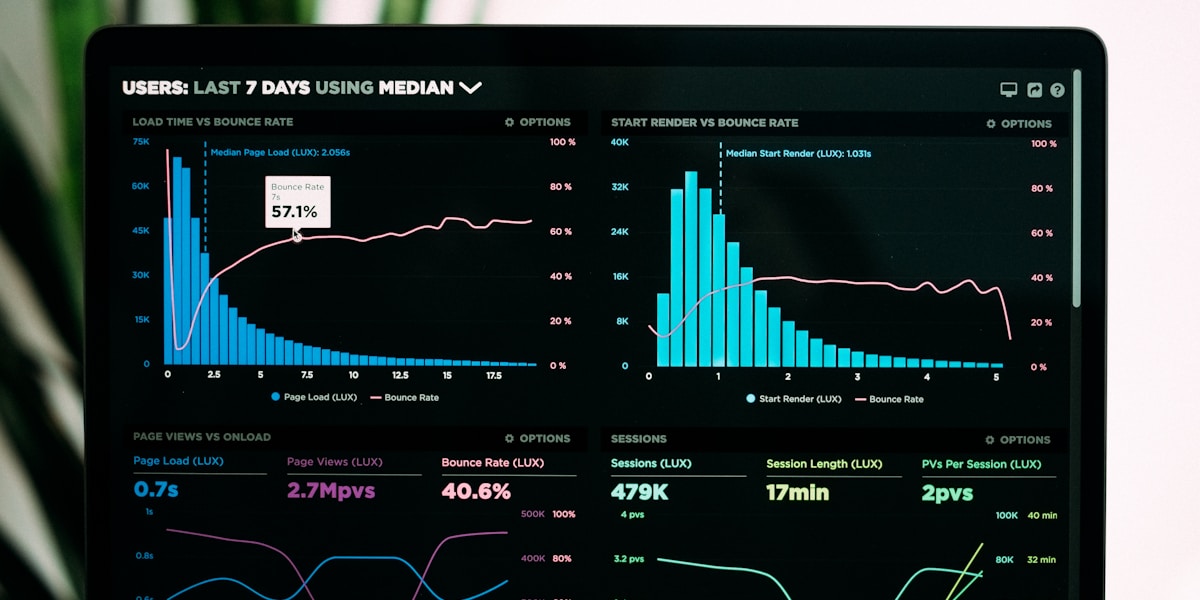
Two competing philosophies shape retail equity research: deep fundamental analysis versus AI-driven signal generation. Photographer: Unsplash
Stock selection has historically demanded a choice between breadth and depth. Retail investors could scan thousands of securities with crude metrics, or analyze dozens with sophisticated models—but rarely both. Stock Rover, founded in 2008, solved this dilemma through exhaustive fundamental data: 700+ metrics spanning two decades of financial history, enabling Warren Buffett-style valuation at scale.
Crowly, launched in mid-2025, proposes an alternative architecture. Rather than providing tools for investor analysis, its multi-agent AI system performs the analysis itself—ingesting technical patterns, sentiment signals, and institutional positioning to generate explicit buy/sell recommendations with confidence scores. Where Stock Rover asks "what do the financials reveal?", Crowly asks "what should I trade today?"
The platforms serve overlapping markets—active US equity investors—but their methodologies reflect incompatible assumptions about time horizons, skill requirements, and the nature of market edge itself.
The Fundamentalist's Arsenal
Stock Rover's value proposition centers on comprehensive fundamental research infrastructure. The platform provides access to over 700 GAAP-compliant metrics across Premium Plus tier, including 20-year historical financials, custom formula builders, and peer comparison tools that evaluate competing stocks across valuation, growth, quality, and momentum dimensions.
The screening engine distinguishes Stock Rover within the research platform category. Users can construct multi-factor screens combining profitability ratios (ROIC, ROE), valuation metrics (P/E, EV/EBITDA, PEG), growth rates (revenue CAGR, earnings growth), and quality indicators (debt-to-equity, current ratio, Piotroski F-Score). Backtesting functionality validates screen performance across historical periods, measuring strategy returns against benchmarks like the S&P 500.

Stock Rover's 700+ metrics enable deep-dive fundamental analysis across income statements, balance sheets, and cash flow statements. Photographer: Unsplash
Portfolio management capabilities extend beyond passive tracking. The platform offers Monte Carlo simulations projecting probabilistic outcomes based on historical volatility, correlation matrices identifying diversification gaps, and rebalancing tools that generate tax-efficient trade recommendations. Dividend investors access specialized modules forecasting future income streams based on payout ratios, coverage metrics, and growth trajectories.
Stock Rover's proprietary scoring systems—evaluating stocks on value, growth, quality, financial strength, dividends, and momentum—provide algorithmic shortcuts for investors seeking systematic approaches without custom model construction. Fair value estimates using discounted cash flow and dividend discount models benchmark current prices against intrinsic worth, calculating margin of safety percentages.
Pricing reflects functionality tiers: Essentials at $7.99 monthly (275 metrics), Premium at $17.99 monthly (375 metrics), and Premium Plus at $27.99 monthly (700 metrics). Annual subscriptions offer approximately 25% discounts. A free tier with limited metrics and watchlist capacity serves casual users.
The AI Execution Engine
Crowly's architecture inverts the research paradigm. Where Stock Rover supplies raw materials for investor judgment, Crowly's five parallel AI models synthesize disparate inputs into actionable directives. The system ingests technical indicators (moving averages, RSI, MACD), fundamental snapshots (P/E, revenue growth, margins), news sentiment scoring, social media signal detection (Reddit WallStreetBets, Twitter/X), and institutional flows via 13F hedge fund filings.

Crowly deploys five AI models in parallel, each analyzing distinct data streams to generate unified trading recommendations. Photographer: Unsplash
The platform's market regime classification represents its core differentiation. Each session, Crowly categorizes overall market conditions as "StrongUp" (bullish momentum with low volatility), "StrongDown" (bearish pressure with high conviction), or "Chop" (directionless, range-bound action). This regime determines recommended exposure levels, directional bias, and risk parameters.
Signals include explicit buy, sell, or hold classifications with confidence percentages (60%, 75%, 90%). ATR-based stop-loss and profit target levels accompany each recommendation, providing mechanical risk management without discretionary judgment. Real-time alerts deliver via web dashboard, mobile app, email, and SMS—ensuring traders receive signals regardless of platform.
The hedge fund tracking module monitors over 50 institutional investors, alerting users when billionaire managers like Bill Ackman, Carl Icahn, or Ray Dalio initiate or exit positions. This "smart money" following assumes institutional research teams identify opportunities retail investors lack resources to discover independently.
Crowly targets active traders with short-to-medium holding periods (days to weeks), contrasting with Stock Rover's appeal to long-term investors analyzing quarterly earnings and multi-year trends.
Philosophical Architecture
The platforms embody different theories of investor competence and market efficiency. Stock Rover assumes investors possess (or can develop) the analytical skill to interpret financial statements, construct valuation models, and identify mispriced securities through systematic research. Its tools amplify human judgment rather than replace it.
This philosophy aligns with value investing traditions established by Benjamin Graham and refined by Warren Buffett—patient analysis of business fundamentals, margin of safety calculations, and conviction-weighted position sizing based on confidence in one's research. Stock Rover democratizes the infrastructure hedge funds use for fundamental research, previously accessible only through Bloomberg terminals or FactSet subscriptions costing thousands monthly.

Stock Rover's comprehensive fundamental tools serve long-term investors building conviction through deep business analysis. Photographer: Unsplash
Crowly operates on opposing assumptions: that retail traders lack time, expertise, or discipline for rigorous fundamental analysis, and that machine learning models can identify patterns in multi-dimensional data humans cannot process. By generating explicit signals, the platform eliminates interpretive paralysis—the phenomenon where investors overwhelmed by information defer decisions indefinitely.
This reflects the quantitative revolution in institutional markets. Renaissance Technologies, Two Sigma, and Citadel Securities deploy AI models analyzing millions of data points to identify fleeting inefficiencies. Crowly extends this algorithmic approach to retail traders, offering institutional-quality pattern recognition at consumer pricing.
Yet the approaches carry distinct risks. Stock Rover users face analysis paralysis—drowning in 700 metrics without clear synthesis frameworks. Crowly's risks involve black-box dependence. Users receiving buy signals without understanding underlying rationale cannot adapt when market regimes shift.
Feature Comparison
| Capability | Stock Rover | Crowly |
|---|---|---|
| Primary Focus | Fundamental Analysis & Screening | AI Trading Signals & Regime Analysis |
| Data Depth | 700+ metrics, 20-year history | Technical + Sentiment + Institutional |
| Target Investor | Long-term value/dividend investors | Active traders (days-to-weeks) |
| Stock Screening | Multi-factor, backtestable | AI-driven recommendations |
| Portfolio Tools | Monte Carlo, correlation, rebalancing | Real-time position monitoring |
| Valuation Models | DCF, DDM, Fair Value, Margin of Safety | Not applicable |
| AI Capabilities | Scoring systems, pattern alerts | 5-model ensemble, regime classification |
| Institutional Tracking | Not available | 50+ hedge funds (13F filings) |
| Alert Delivery | Email notifications | Web, mobile, email, SMS |
| Custom Formulas | Yes (custom metric builder) | No |
| Backtesting | Screen strategy backtesting | AI-optimized backtester |
| Pricing (Monthly) | $7.99 - $27.99 | Free tier + Premium |
| Asset Coverage | US & Canada (stocks, ETFs, mutual funds) | US equities focused |
Use Case Segmentation
Stock Rover Ideal Users
- Value investors seeking undervalued businesses
- Dividend investors building income portfolios
- Fundamental analysts comfortable with financial statements
- Portfolio managers requiring institutional-grade tools
- Long-term investors (1-10 year horizons)
- Quantitative investors backtesting strategies
Crowly Ideal Users
- Active day/swing traders
- Time-constrained professionals seeking signals
- Traders following institutional flow
- Algorithm-followers comfortable with AI systems
- Short-term traders (days-to-weeks)
- Momentum/trend followers

Active traders prioritizing speed and real-time signals gravitate toward AI-driven platforms like Crowly. Photographer: Unsplash
Key Insight
The platforms are not substitutes but serve fundamentally different trading philosophies. Stock Rover empowers independent analysis; Crowly provides algorithmic decision support. Investors must first clarify their own investment approach before selecting tools.
Integration and Complementarity
Sophisticated investors may deploy both platforms in complementary roles. Stock Rover can identify fundamentally sound businesses trading below intrinsic value through comprehensive screening—generating a watchlist of 20-30 attractive long-term holdings. Crowly's AI signals then time entries within that pre-screened universe, using technical analysis and institutional flow to optimize purchase points.
This hybrid approach combines Stock Rover's strategic stock selection with Crowly's tactical timing. An investor might use Stock Rover to identify that Microsoft trades at a 15% discount to fair value based on DCF analysis, then wait for Crowly's AI to signal a "StrongUp" regime with 85% buy confidence before deploying capital.

Sophisticated investors increasingly combine fundamental screening tools with AI-driven timing signals for hybrid strategies. Photographer: Unsplash
Performance Validation
Stock Rover's value proposition requires no external validation—the platform either provides advertised metrics and tools, or it does not. Users can immediately verify data accuracy by comparing Stock Rover figures against SEC filings (10-K, 10-Q reports).
Crowly's signal-based model demands rigorous performance measurement. Without audited track records, independent validation, or regulatory registration, performance claims remain unverifiable. Meaningful evaluation requires performance across complete market cycles, multiple volatility regimes, and various macro environments.

Validating AI trading signal performance requires multi-year track records across different market regimes. Photographer: Unsplash
Market Context and Competition
Neither platform operates in vacuum. Stock Rover competes with Morningstar Premium ($249 annually), Seeking Alpha Premium ($239 annually), and YCharts (starting at $299 monthly). Within the AI signal category, Crowly competes with Trade Ideas ($118 monthly), TipRanks ($29.95 monthly), and MarketAlerts.ai.

The investment research platform category fragments across fundamental analysis tools, AI signal generators, and hybrid solutions. Photographer: Unsplash
Brokerage platforms increasingly bundle research tools natively. As brokers enhance built-in capabilities, standalone research platforms must justify subscription costs through superior functionality. Stock Rover maintains advantage through analytical depth—custom formulas, Monte Carlo simulations, and 20-year historical data. Crowly's AI edge requires demonstrating superior performance versus simple technical indicators available free through TradingView or Yahoo Finance.
The Verdict
Stock Rover and Crowly address different questions. Stock Rover answers "which businesses are fundamentally attractive?" through exhaustive quantitative analysis. Crowly answers "what should I trade today?" through algorithmic signal generation. Neither approach is inherently superior—appropriateness depends on investor objectives, time horizons, and analytical preferences.
For long-term investors seeking to build conviction through fundamental research, Stock Rover's tools provide professional-grade infrastructure at reasonable cost. The platform's 700+ metrics, backtesting capabilities, and valuation models serve those willing to invest time developing analytical skills.
For active traders seeking systematic signals without deep analysis, Crowly offers potential efficiency—assuming AI models perform as claimed. The hedge fund tracking and regime classification provide features unavailable in traditional research platforms, appealing to traders following institutional flow.
The ideal outcome likely involves tool specialization rather than universal adoption. As machine learning advances and fundamental data proliferates, future platforms might combine Stock Rover's analytical depth with Crowly's AI synthesis—offering both comprehensive metrics and intelligent recommendations. Until such hybrid systems mature, investors face a binary choice: master the tools, or trust the algorithm.